Coupons, flash sales, and referral programs — these are just a few of the proactive marketing strategies any cosmetic manufacturer and brands use to strengthen customer loyalty and foster long-term relationships.
One tool that has stood the test of time is the strategic use of sample packets or freebies.
Businesses offer cosmetic sample packets or free trials as a classic give-and-take. When businesses give customers something for free, customers not only experience the product or service but are inclined to return the favor.
However, the core question remains: can sample packets lead to repeat customers?
Medpak Solutions, a cosmetic manufacturer, investigates the role of sample packets in repeat purchases. Read on to learn more.
Product sampling occurs when customers can try miniature versions of a product for free before making a purchase decision. For example, providing free samples of a moisturizer allows the company to demonstrate its positive results to customers before they commit to buying the full-price product.
Free samples capitalize on this by allowing customers to interact with and assess the product before deciding if it merits the retail price.
Introducing a new product through sampling is highly effective. According to a phone survey conducted by Marsh Supermarkets, consumers indicated a likelihood of trying a new product with a coupon, and 28% expressed willingness to try a new product if they could sample it.
Product sampling occurs when customers can try miniature versions of a product for free before making a purchase decision. For example, providing free samples of a moisturizer allows the company to demonstrate its positive results to customers before they commit to buying the full-price product.
Our client, a well-known name in cosmetics and skincare, faced challenges with high customer acquisition costs and low repeat purchases. Their high-quality products did not ensure customer loyalty or sustained sales beyond the initial transaction.
After analyzing their acquisition strategy, we discovered they spent between $60 and $85 per new and repeat customer. This cost is typical for many cosmetic and skincare brands and is widely accepted as a standard Cost-Per-Acquisition in the industry.
Medpak Solutions implemented Sample Packets as a strategic initiative based on Arizona State University research. Our team increased customer acquisition costs slightly to develop these packets, which included small samples of additional products.
Here’s a visual representation of the brand’s product range and the selection for the sample packets.
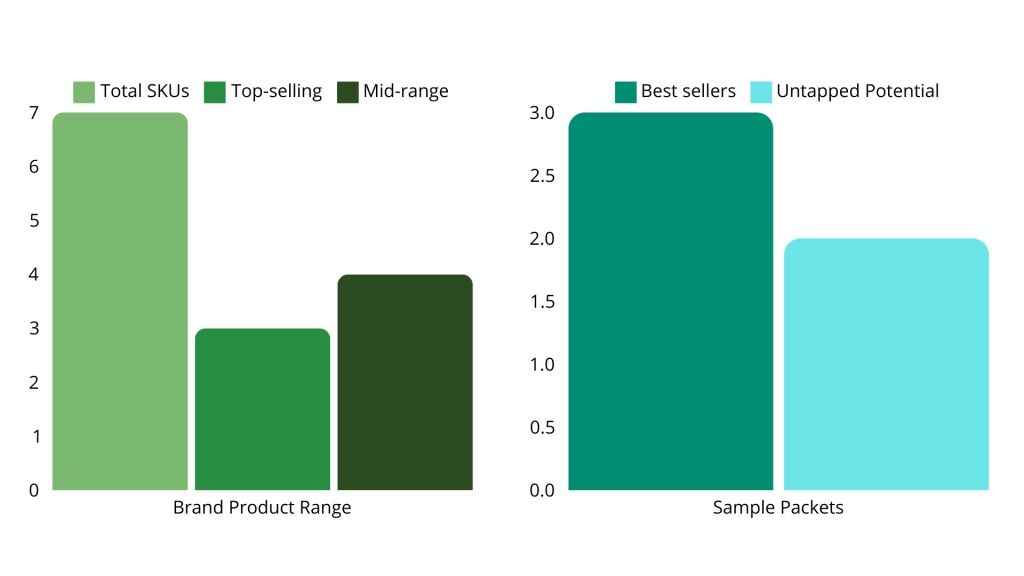
The first chart shows the total SKUs, top-selling products, and mid-range performers. The second chart displays the SKU breakdown in the sample packets, highlighting the bestsellers and products with untapped potential.
The cost per client acquisition for cosmetic brands typically ranges from $50 to $80. However, Medpak adds an additional $2-3 to this cost to provide sample packets. These packets include small samples of additional products offered when a client makes a purchase. In initial orders, including samples from other products has shown a 22% increase in retention rates.
Furthermore, we included a personalized thank-you note to enrich the overall customer experience. Bundling these sample packets allowed customers to explore a more extensive assortment of products and gave them a reason to return for future purchases.
Just two months after implementing the Sample Packet strategy, the brand saw a remarkable 22% increase in sales. Furthermore, this growth occurred without a significant increase in customer acquisition costs. The primary catalyst for this success was the substantial increase in repeat purchases. While the number of new customers remained steady, there was a notable rise in returning customers making additional purchases. Giving customers a taste of their product range boosted engagement and fostered loyalty among the customer base.
Humans have an innate tendency to reciprocate kindness. When we receive a freebie—whether it’s a gift, a sample product, or a discount code—we feel inclined to reciprocate. This principle of reciprocity motivates positive actions such as making purchases, referring to a restaurant, or leaving positive reviews.
Robert Cialdini explores the “rule of reciprocation” in his book “Influence: The Psychology of Persuasion.” This concept underscores the universal human tendency to feel obligated to repay or reciprocate when given something.
Throughout history and across various cultures, people have had a strong impulse to return gifts or favors with something of their own.
Paleoanthropologist Richard Leakey argued that human evolution has been shaped by this system of reciprocity, stating, “We are human because our ancestors learned to share their food and skills within a respected network of obligation.”
Reciprocity isn’t just about deepening relationships—it’s a powerful tool for gaining compliance. According to Cialdini & Goldstein (2004), it can sway decisions in your favor. The researchers discovered that customers feel compelled to reciprocate, leading them to feel “locked” into these relationships. This sense of obligation can significantly influence customer loyalty and satisfaction.
In compliance experiments, a company, often an agent of influence, provides a favor to a target. Once the target accepts the gesture, they feel a sense of indebtedness to reciprocate, thereby increasing the likelihood of agreeing to subsequent requests. This initial generosity can pave the way for future purchases, as customers naturally wish to reciprocate the favor. Public relations packaging, customized gifts, or rewards further enhance reciprocity.
Giving away freebies also demonstrates that a company values its customers and pays attention to their individual needs and preferences. This strengthens the bond by demonstrating the brand’s investment in customer retention and allowing them to try products without additional commitment.
This case highlights how Medpak Solutions’ Sample Packet strategy effectively boosts sales and fosters customer loyalty in the cosmetic and skincare sectors. By investing just 1% more in customer acquisition, brands can cultivate enduring relationships with their audience. Partnering with a reliable cosmetic manufacturer with expert guidance is necessary for sustainable brand growth.
Medpak’s streamlined manufacturing process and integrated fulfillment services ensure cost efficiency and quicker time-to-market. Innovative solutions in a dynamic beauty industry provide a competitive advantage in a crowded marketplace.
Reach out to a cosmetic manufacturer today and discover how we can help your brand overcome its challenges.