
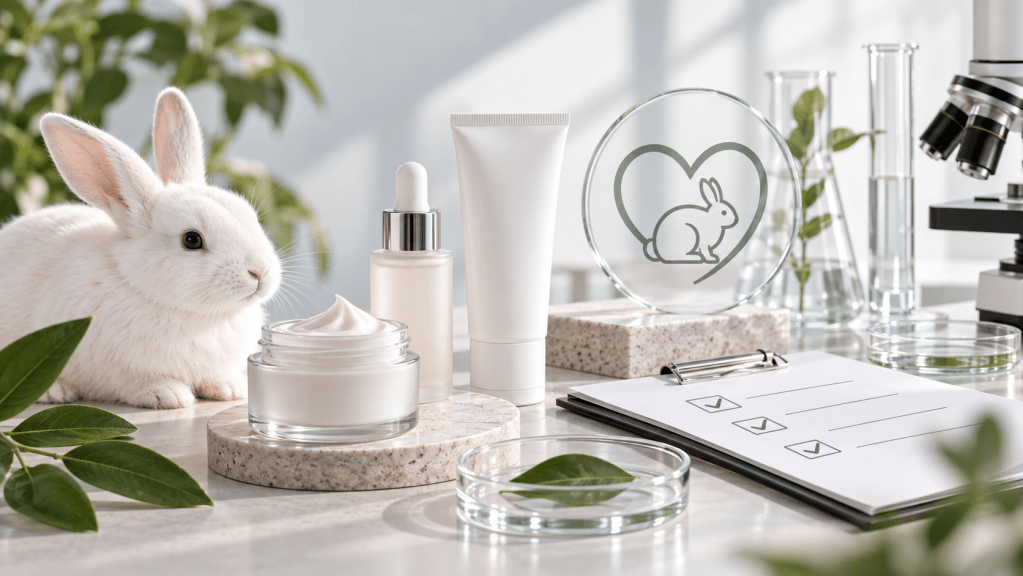
A cruelty-free statement may look simple on a package, but substantiating it can require much more than confirming that the finished product was not tested on animals. Brands need to understand what their claim covers, how ingredients were evaluated, what third-party manufacturers and laboratories do, and whether supplier practices remain consistent over time.
For U.S. brands, this matters because the FDA says the terms “cruelty-free” and “not tested on animals” do not have legal definitions. FDA explains that companies may use these phrases differently, including cases where a claim applies only to the finished product while raw-material suppliers or contract laboratories may have used animal testing. That makes documentation and claim scope central to brand due diligence.
This guide focuses on the operational side of cruelty free cosmetic claims: what to request from suppliers, how to review manufacturing and testing policies, how voluntary certification programs differ from self-declared claims, and what records to maintain before making a statement on packaging or marketing materials.
| KEY TAKEAWAYS“Cruelty-free” is not a federally defined cosmetic term in the United States, so brands should define the scope of their own claim clearly.A finished-product statement is not enough if the brand intends the claim to cover ingredients, suppliers, contract manufacturers and external laboratories.Supplier declarations, testing policies, change-notification procedures and certification records can help substantiate the claim; a COA alone does not prove animal-testing status.Certification programs are voluntary and use their own standards. Brands should not display a certification logo or imply certification unless approval has actually been granted.Cruelty-free status should be monitored as an ongoing supply-chain requirement, not treated as a one-time onboarding question. |
|---|
Before asking suppliers for documents, define the claim itself. A vague internal standard creates inconsistent answers later, especially when a brand works with multiple raw-material suppliers, laboratories or manufacturers.
A brand policy should clarify whether “cruelty-free” is intended to cover:
This distinction is important because the FDA notes that companies can use “cruelty-free” or “not tested on animals” language even though there is no uniform federal definition for those phrases. A brand therefore needs an internal standard that is specific enough to support the wording it puts in front of consumers.
For a broader overview of the topic, MedPak’s page on cruelty-free cosmetics explains the basic distinction between cruelty-free positioning and other product attributes such as vegan formulation. This article goes a step further by focusing on documentation and verification.
Cruelty-free due diligence is a supply-chain exercise. Brands should know which organizations can affect the claim before deciding what evidence to collect.
Depending on the product, that list may include:
When an ingredient is purchased through a distributor, the distributor may not be the organization that made the raw material. For a claim that extends to ingredient-level testing, the brand may need information that reaches back to the original manufacturer rather than stopping at the immediate seller.
The strongest records are those that answer the animal-testing question directly. General quality documents are valuable for manufacturing, but they should not be treated as proof of cruelty-free status unless they specifically address the relevant testing practices.
| Document or Evidence | Why It Helps | What It Does Not Prove by Itself |
|---|---|---|
| Signed animal-testing / cruelty-free declaration | Directly records the supplier’s policy and the scope of the statement. | It may not cover upstream manufacturers unless the declaration explicitly says so. |
| Supplier animal-testing policy | Explains whether the organization conducts, commissions or permits testing and under what circumstances. | A general policy may not identify every material supplied to your brand. |
| Ingredient-specific declaration | Connects the statement to a particular raw material or ingredient code. | It may need renewal if the source, manufacturing process or supplier changes. |
| Third-party laboratory statement | Clarifies whether outsourced testing involves animals. | It does not address ingredient suppliers unless they are included. |
| Certification or program approval | Shows that the company or brand has met a defined third-party program standard. | Different programs have different criteria; certification is not FDA approval. |
| COA, specification or technical data sheet | Supports identity, quality and batch specifications. | A COA normally does not establish animal-testing status unless it explicitly says so. |
For higher-risk or strategically important claims, brands may also ask suppliers to agree to notification requirements if their animal-testing policy, raw-material source, manufacturing site or regulatory status changes.
A raw-material supplier can have a compliant policy while a separate laboratory follows different practices. The same is true for a contract manufacturer. Each organization that could commission or conduct testing should be reviewed within the scope of the brand’s claim.
When evaluating a manufacturing partner, ask:
MedPak states in its cosmetic manufacturing FAQ that it does not perform animal testing in its contract manufacturing and laboratory processes. Brands should still retain the written records relevant to their own products and claims, particularly when third-party ingredient suppliers or testing providers are involved.
A brand can adopt an internal cruelty-free policy without joining a voluntary certification program, but the two approaches should not be presented as if they are identical.
A self-declared claim depends on the brand’s own standard, supplier documentation and compliance controls. Because there is no FDA definition of “cruelty-free,” the brand should be able to explain what its statement means and retain records supporting that meaning.
Programs establish their own criteria. For example, the Leaping Bunny standard includes a fixed cut-off date, supplier monitoring requirements and independent auditing provisions. Its materials also require participating companies to collect declarations from ingredient suppliers and product manufacturers.
PETA’s Beauty Without Bunnies program uses a different process. According to PETA’s program requirements, applicants submit a signed assurance and supporting information, and are expected to have agreements with suppliers addressing animal testing.
These programs are examples of voluntary standards, not government approvals. A brand should never reproduce a certification mark, state that it is certified, or imply participation in a program unless it has actually completed that program’s approval process and follows its current trademark/licensing rules.
These terms address different questions. “Cruelty-free” generally concerns animal-testing practices, while “vegan” concerns whether a product contains animal-derived ingredients or by-products. A product can potentially meet one standard without meeting the other.
That distinction should be reflected in supplier questionnaires. If a brand wants both claims, it should collect evidence for both instead of assuming that cruelty-free documentation automatically substantiates vegan status.
The FDA states that the Federal Food, Drug, and Cosmetic Act does not specifically require animal testing to establish cosmetic safety. However, manufacturers remain responsible for substantiating the safety of ingredients and finished products before marketing. FDA’s Animal Testing & Cosmetics guidance also notes the agency’s support for alternative methods that reduce, refine or replace whole-animal testing where scientifically appropriate.
For brand teams, this means the compliance question is not “Can we skip safety evaluation?” The better question is “What evidence and testing are appropriate for this formula, its ingredients, its packaging and its intended use?”
Depending on the product, a safety and quality program may draw from:
The appropriate testing plan depends on the product. Cruelty-free positioning should not be used as a reason to reduce the level of safety substantiation required for a responsible launch.
A due-diligence file can be strong while the consumer-facing wording is still too broad. Review every place where the claim appears, including packaging, ecommerce pages, retailer applications, marketplace listings, social media and sales materials.
Questions for the final marketing review include:
Supplier documentation should not become a static folder that is never reviewed again. A formula can remain unchanged while the source behind an ingredient changes, a raw-material manufacturer changes ownership, or a supplier updates its testing policy.
A practical monitoring process can include:
Certification programs may specify their own monitoring frequency. For brands using a self-declared standard, the review schedule should be proportionate to the claim, supply-chain complexity and likelihood of change.
☐ Define what “cruelty-free” means under the brand’s internal policy.
☐ List ingredient manufacturers, distributors, laboratories and contract manufacturers that can affect the claim.
☐ Collect signed animal-testing declarations from relevant suppliers.
☐ Confirm whether declarations apply to the specific ingredient or to the supplier generally.
☐ Ask whether testing is conducted, commissioned, paid for or permitted by third parties.
☐ Document the manufacturer’s and external laboratory’s testing policies.
☐ Keep COAs and specifications for quality purposes, but do not treat them as cruelty-free evidence unless they directly address testing status.
☐ Confirm certification status before using any third-party logo or the word “certified.”
☐ Review market-specific requirements before expanding distribution.
☐ Set a schedule for renewal, change notification and supplier re-verification.
☐ Review packaging, website and retailer claims against the documentation before publication.
Cruelty-free positioning is strongest when the marketing statement is the final output of a documented process—not the starting point. Brand teams should define the claim, trace the supply chain, collect evidence, verify the practices of manufacturers and laboratories, and keep the records current as products and suppliers change.
That approach protects more than a label statement. It gives product development, regulatory, procurement and marketing teams a shared standard for evaluating ingredients and manufacturing partners before a new product reaches the market.
Planning a cruelty-free skincare or personal-care product? Talk with the MedPak Solutions team about your formulation and manufacturing requirements.
No. The FDA states that there are no legal definitions for the terms “cruelty-free” or “not tested on animals” in cosmetic labeling. Brands should therefore define their claim clearly and retain evidence supporting the scope they communicate.
The Federal Food, Drug, and Cosmetic Act does not specifically require animal testing for cosmetic safety. However, companies remain responsible for adequately substantiating the safety of their ingredients and finished products before marketing.
Usually not. A COA is primarily a quality document describing characteristics or test results for a material or batch. Cruelty-free substantiation should come from documentation that specifically addresses animal-testing policies and practices.
No. Cruelty-free relates to animal-testing practices, while vegan generally relates to whether animal-derived ingredients or by-products are present. If a brand makes both claims, each should be substantiated separately.
No. Programs such as Leaping Bunny or PETA’s Beauty Without Bunnies are voluntary third-party programs, not FDA certification programs. Brands should follow the specific requirements of any program they choose to join.
There is no single federal review interval for a self-declared claim. Brands should define a documented schedule and re-check records when suppliers, ingredient sources, manufacturing sites or testing policies change. Third-party certification programs may impose their own monitoring requirements.