
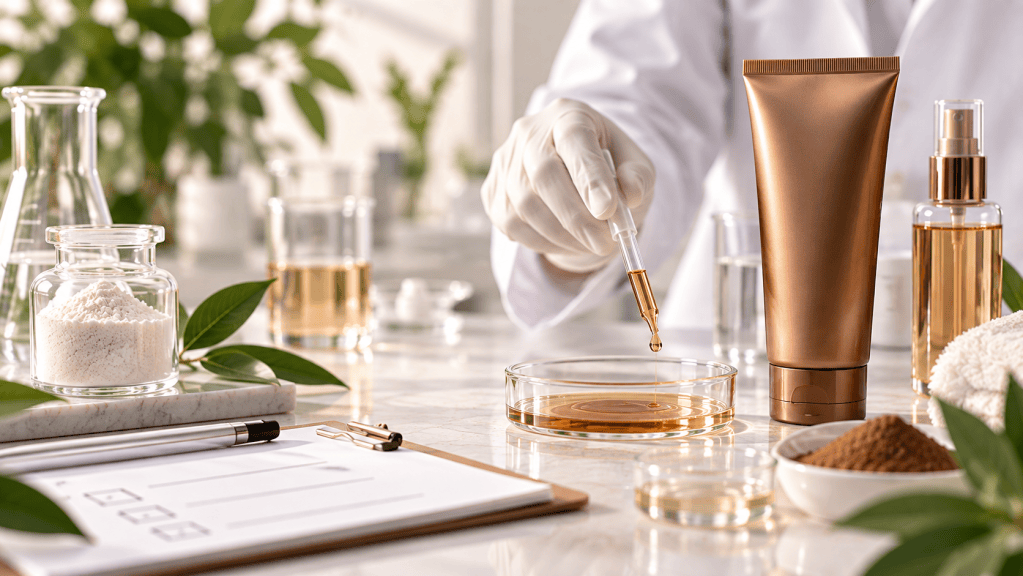
Dihydroxyacetone (DHA) is the ingredient that gives many sunless tanning products their color-development effect, but a strong self-tanning product depends on more than having DHA on the ingredient list.
Raw-material specifications, storage history, formulation pH, ingredient compatibility, packaging, manufacturing controls and finished-product testing can all influence product quality.
For brands comparing self-tanning suppliers or manufacturers, the useful question is not simply, “Do you use DHA?” It is, “How is the DHA specified, handled, formulated and controlled from raw material through finished product?”
That distinction matters because DHA is chemically reactive. The same characteristic that lets it react with amino acids in the outermost layer of skin to create visible color can also make it sensitive to formulation and storage conditions.
This guide explains the questions brands should ask when evaluating DHA quality for self-tanning products, while keeping product claims within appropriate cosmetic boundaries.
| Key TakeawaysDHA quality should be assessed through raw-material specifications, handling, formulation, stability and finished-product controls.pH is important, but the correct target must be established for the complete formula rather than copied from another product.Supplier documentation does not replace finished-product stability and packaging evaluation.Sunless tanning color should not be presented as UV protection or a substitute for sunscreen.Sourcing decisions should consider traceability, technical support and batch consistency—not price alone. |
DHA is a color additive used in sunless tanning cosmetics. FDA explains that DHA darkens the skin through a reaction with amino acids in the skin’s surface.
In the United States, DHA is permitted for use in externally applied cosmetics intended to impart color to the human body, subject to the conditions in the applicable color-additive regulation. See the FDA’s Sunless Tanners & Bronzers guidance.
That regulatory point is important for product development. DHA-containing self-tanners are cosmetic products intended to create the appearance of a tan. They should not be marketed as providing sun protection unless the product separately meets the requirements applicable to sunscreen drugs.
A brand should know more about its DHA than the trade name or supplier marketing description.
Useful documentation may include:
FDA’s color-additive regulation for DHA includes specifications and impurity limits. A manufacturer should therefore be able to confirm that the material selected for a U.S. self-tanning cosmetic is appropriate for its intended regulated use.
A COA is useful, but brands should not treat it as the entire quality system. The manufacturer also needs a process for receiving, identifying, storing and releasing raw materials before production.
DHA quality can be affected by storage and environmental conditions before it ever reaches the mixing vessel.
Brands should ask:
A high-quality raw material can still create manufacturing risk if it is stored or handled poorly. For private-label brands, this is one reason to evaluate the manufacturer’s incoming-material and inventory controls rather than focusing only on the finished sample.
DHA stability is strongly connected to the chemistry of the finished system.
Peer-reviewed literature on DHA sunless tanning formulations identifies pH as an important stability variable. A 2022 review also describes DHA as a highly reactive molecule that creates formulation challenges. See the Journal of Cosmetic Dermatology review indexed in PubMed.
Formulators should not reduce this to a simplistic rule such as “lower pH is always better.” The final pH has to work for DHA stability, the preservation strategy, other ingredients, rheology, skin feel, packaging and the full product format.
Buffers and acids also need to be evaluated for compatibility. The right pH target is therefore a formula-development decision supported by stability data, not a number that should be copied from another product.
Self-tanning formulas are often more complex than DHA plus water. A mousse, lotion, cream, mist or serum may also include humectants, emollients, thickeners, surfactants, botanical extracts, fragrance, antioxidants, supporting colorants, erythrulose or other ingredients.
Compatibility screening should look for:
This is why DHA quality should be evaluated in the finished formulation, not only from the supplier’s raw-material specification.
Manufacturing technique also matters. Depending on the product format, the formulator may need to control water quality, addition sequence, mixing time, mixing intensity, temperature, cooling conditions, exposure time before filling, air incorporation and hold times.
DHA is reactive, so unnecessary heat or extended processing exposure may be undesirable depending on the formula and supplier guidance.
Brands do not need to prescribe the manufacturing process themselves, but they should expect the manufacturer to have documented procedures and batch records that define how the product is made consistently.
Supplier documentation tells you about the raw material. It does not prove that the final self-tanner will remain acceptable throughout its intended shelf life.
A finished-product evaluation plan may consider:
The exact program depends on the formula, package and risk profile. Brands should ask what testing is appropriate for the product they are developing rather than assuming that one universal test schedule applies to every self-tanner.
Packaging is not just a branding decision. It can influence product exposure to air, light, moisture and repeated consumer contact, and it must dispense the formula consistently.
Questions to consider include:
A successful bulk formula can still become a poor commercial product if the package is not compatible with it.
This is one of the most important claim controls for self-tanning brands.
FDA states that DHA-containing sunless tanning products create color on the skin but do not inherently protect against ultraviolet radiation.
FDA also requires a warning statement on tanning products without sunscreen explaining that the product does not contain a sunscreen and does not protect against sunburn. See FDA’s required warning statement for tanning products without sunscreen.
Claims such as “sun-safe tan,” “protective tan,” or wording that suggests DHA replaces sunscreen should therefore be reviewed carefully. Self-tanning product positioning should stay focused on cosmetic appearance unless the product separately qualifies for additional regulated claims.
Creams, lotions and mousses applied externally to the skin present different exposure conditions from spray systems.
FDA authorizes DHA for external application and has specifically noted concerns with spray-booth use when consumers may inhale the product or expose the eyes, lips or mucous membranes.
For brands developing a spray or mist format, intended use and exposure should therefore be evaluated carefully. The format should influence directions for use, package design, warnings, application guidance, claims and risk assessment.
A supplier or manufacturer should be willing to discuss these distinctions rather than treating every DHA format as interchangeable.
When comparing sourcing channels, brands should look beyond unit cost.
A useful sourcing review can include traceability, raw-material specifications, lot-specific COAs, storage controls, technical support, supplier change notification and continuity of supply. This is where a comparison of a tanning supplier vs distributor becomes relevant: the decision should be based on documentation and support as well as price.
The same logic applies when sourcing wholesale tanning supplies. Product quality depends on how raw materials, formula development, manufacturing and quality controls work together.
| Review Area | Questions to Ask |
| Raw material | What specification and assay range are used? Is a lot-specific COA available? What impurity limits, storage requirements and supplier-change controls apply? |
| Formulation | What pH target is being used and why? Have formula ingredients been screened for compatibility? How are color, odor and pH drift monitored? |
| Processing | What addition sequence and temperature controls are required? How are batch instructions and manufacturing conditions documented? |
| Finished product | What stability, microbiological and packaging-compatibility work is planned? What finished-product specifications determine release? |
| Claims & use | Are claims limited to cosmetic appearance? Does the product avoid suggesting UV protection? Are spray/mist exposure considerations addressed where relevant? |
For a private label tanning formulation, ingredient quality is not just a purchasing issue.
The manufacturer has to connect raw-material selection with formula architecture, quality specifications, stability, packaging, manufacturing controls, consumer use and claims.
That is why two products using DHA can perform very differently. A well-controlled product-development process gives brands a stronger basis for consistent color development, acceptable sensory performance and repeatable commercial production without making promises the formula cannot support.
DHA is the foundation of many self-tanning formulas, but its presence alone says little about the quality of the finished product.
Brands should evaluate the complete chain: supplier documentation, regulated use, storage, formulation conditions, processing, stability, packaging and claims.
The most useful manufacturing partner is not simply one that can source DHA. It is one that can explain how DHA is controlled within the finished product and what evidence supports the decisions made along the way.
| Developing a private label self-tanning product?MedPak Solutions can help brands evaluate product format, formulation requirements, packaging and commercial manufacturing considerations.Contact MedPak Solutions |
Dihydroxyacetone (DHA) is a color additive commonly used in sunless tanning products. It reacts with amino acids in the outermost layer of skin to create a temporary darker appearance.
No. Finished-product performance depends on the entire formulation, including the DHA specification, pH, supporting ingredients, processing, packaging and stability. More DHA is not automatically better.
Brands and manufacturers commonly review a raw-material specification, lot-specific Certificate of Analysis, storage and handling guidance, shelf-life information and technical documentation appropriate to the material and target market.
DHA is chemically reactive, and pH can influence its stability. The appropriate pH should be established for the complete formula because other ingredients, preservation, skin feel and packaging also matter.
No. FDA states that sunless tanning products do not inherently provide sunscreen protection. A self-tanner should not be treated as a substitute for a compliant sunscreen product.
FDA permits DHA for external application, but the agency has raised concerns about spray applications that may expose the eyes, lips, mucous membranes or result in inhalation or ingestion. Brands developing spray formats should review intended use and exposure carefully.