
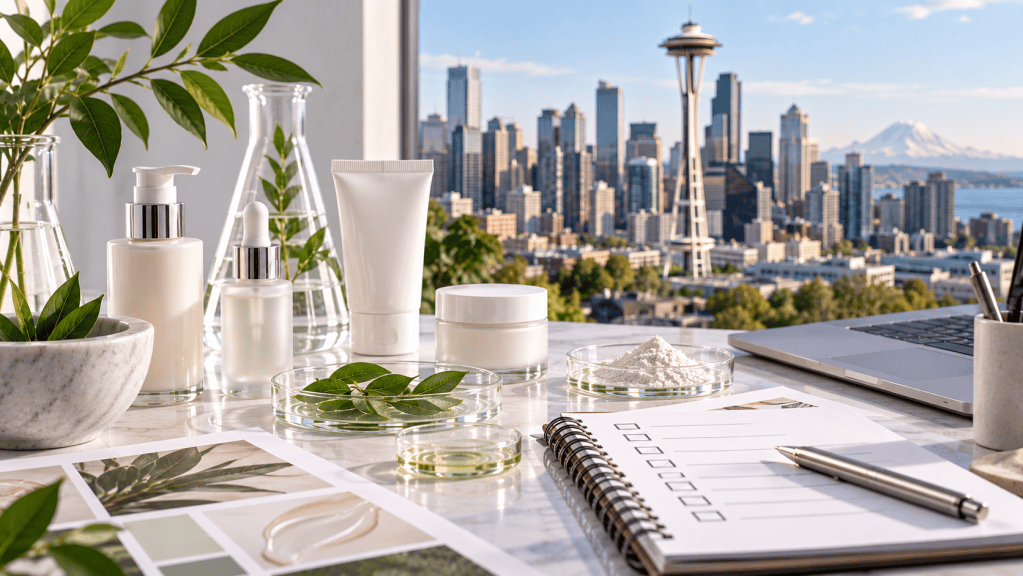
Launching a skincare brand in Seattle takes more than finding a formula you like and choosing attractive packaging. Before a first commercial run can be scheduled, a manufacturer needs enough information to understand what you are making, how it should be filled and packaged, what quality requirements apply and when the product needs to be ready.
For Seattle founders, the most useful early work is production planning. A clear product brief, realistic SKU strategy and organized packaging and testing decisions can reduce unnecessary revisions once a project reaches manufacturing.
This guide focuses on the decisions that help a founder prepare for production without duplicating the role of a dedicated manufacturer-location page. It is designed for brands that may be based in Seattle while working with a U.S. manufacturing operation located elsewhere.
| What to Have Ready Before You Request ProductionA defined product brief with target format, user, positioning and claims direction.A decision on private label, custom formulation or an existing formula transfer.A realistic first-run quantity and number of launch SKUs.Packaging concepts that are compatible with the product and filling process.A plan for testing, quality specifications, labeling and claims review.A target launch window with room for formulation, components, approvals and production. |
A manufacturer can quote and plan more accurately when the product concept is specific. “I want to launch a moisturizer” leaves too many variables open. A stronger brief explains what the product should be, who it is for and what commercial constraints matter.
At minimum, define:
This information helps the manufacturer determine whether an established formula is suitable or whether additional formulation work is needed.
A new brand does not always need to begin with a fully custom formula. The right route depends on differentiation, timeline, budget, ingredient requirements and how much formulation control the brand needs.
| Development Route | What It Means | Best Fit |
| Private label | Established formulation used as the product foundation | Faster route when an existing formula fits the brief |
| Custom formulation | Formula developed around a defined product brief | When differentiation or technical requirements demand a new formula |
| Formula transfer | Existing brand formula evaluated for manufacturing transfer | Established products moving to a new production relationship |
Make this decision early because it changes the project timeline, sample process, testing needs and the amount of technical development required before production.
A broad launch can create more packaging purchases, more approvals, more inventory and more production coordination than a new brand expects.
Instead of starting with a large catalog, consider which products form the clearest initial routine or solve the strongest customer need. A focused first line can make manufacturing planning easier while giving the brand room to expand after initial demand becomes clearer.
Questions to ask include:
First-run quantity affects more than the finished unit count. It can influence raw-material purchasing, packaging orders, production scheduling, per-unit cost and the amount of inventory the brand must sell before reordering.
Avoid choosing a quantity only because it produces a more attractive unit price. Balance manufacturing requirements with your sales plan, channel strategy, launch budget and realistic demand.
A manufacturer will generally need to know the estimated quantity by SKU before it can evaluate the project in detail. If quantities are still uncertain, provide a practical range rather than leaving the requirement open-ended.
Packaging affects filling, product protection, labeling and the consumer experience. It should be evaluated alongside the formula instead of being chosen after development is complete.
For each product, consider:
A visually appealing package can still create production problems if the pump cannot handle the viscosity, the fill opening is unsuitable or the formula interacts poorly with the component.
Commercial production should be supported by product-appropriate testing and clear quality specifications. The exact plan depends on the formulation, packaging, intended use and risks of the product.
Depending on the project, planning may include:
Testing should be discussed during product development rather than treated as a final step after a launch date has already been promised.
Claims and packaging copy should be reviewed before labels, cartons or decorated components are finalized. Late changes can create rework and delay production even when the formula itself is ready.
FDA explains that cosmetic labeling must be truthful and not misleading. Claims that a product treats or prevents disease, or that it affects the structure or function of the body, can cause the product to be regulated as a drug. Review the FDA cosmetics labeling claims guidance before finalizing U.S. product claims.
Your label-development workflow should confirm required identity, net quantity, ingredient declaration and other applicable labeling elements as well as the marketing language on the package.
A launch date should account for more than the production day. Depending on the project, the schedule may need room for formula selection or development, samples, revisions, testing, packaging procurement, artwork approval, production scheduling, filling and final release.
A useful approach is to work backward from the intended launch window and identify the last responsible date for each major decision.
| Planning Stage | Decision / Output |
| Product brief | Define formula route, product format, claims direction and target quantities |
| Development | Select established formula or complete custom development and samples |
| Packaging | Finalize compatible components, fill sizes and artwork |
| Testing & quality | Complete the product-appropriate evaluation and set release specifications |
| Production readiness | Confirm materials, components, approvals and manufacturing instructions |
| Commercial run | Manufacture, fill, package and complete release steps |
A Seattle-based skincare company can work with a U.S. manufacturer located in another state. The important questions are whether the operation can support the formula, package, production quantity, quality requirements and ongoing communication your brand needs.
If you are comparing options, MedPak provides cosmetic manufacturing support for Seattle brands while commercial manufacturing is coordinated through its Florida operation.
When reviewing an out-of-state manufacturer, ask about:
The objective is to understand the manufacturing relationship, not simply the distance between your office and the plant.
Location pages can describe markets a manufacturer serves, but founders should still verify the physical production site.
MedPak’s U.S. cosmetic manufacturing facility is in St. Petersburg, Florida. The operation coordinates formulation, product development, commercial manufacturing, filling, packaging support and quality-focused testing.
For a Seattle brand, this means the brand can be based in the Pacific Northwest while production is handled through an identified U.S. manufacturing operation in Florida. That distinction should remain clear in marketing and project planning.
☐ Product brief completed
☐ Private label, custom or transfer route selected
☐ Initial SKU count defined
☐ Estimated production quantity provided for each SKU
☐ Packaging format and fill size selected
☐ Formula/package compatibility considered
☐ Testing and quality requirements discussed
☐ Claims and labeling reviewed before print
☐ Target launch window shared with the manufacturer
☐ Physical manufacturing location confirmed
☐ Repeat-order planning considered
The most productive manufacturer conversations start with a clear brief and realistic commercial requirements.
For founders preparing to launch a skincare brand in Seattle, that means defining the formula route, product line, packaging, quantities, quality expectations and timeline before production becomes urgent.
A structured plan helps the manufacturer evaluate the project more accurately and gives the brand a clearer path from concept to the first commercial batch.
| Preparing a skincare line for commercial production?Share your product type, formula status, estimated quantity and target launch timing so the MedPak team can review the project and discuss appropriate next steps.Contact MedPak Solutions |
Start with a clear customer and product concept, then define the product brief, formulation route, initial SKUs, packaging, production quantity and launch timeline. Once those decisions are organized, a manufacturer can evaluate feasibility and the next development steps more accurately.
No. A brand can be based in Seattle and work with an out-of-state U.S. manufacturer. The important factors are manufacturing capability, communication, quality systems, packaging and filling fit, production requirements and a clear understanding of where the product is actually made.
MedPak’s physical cosmetic manufacturing operation is in St. Petersburg, Florida. The facility supports formulation, product development, commercial manufacturing, filling, packaging support and quality-focused testing.
Private label can be useful when an established formula already fits the brand brief. Custom formulation is more appropriate when the brand needs a new formula, specific sensory profile, ingredient requirements or stronger technical differentiation.
There is no universal number. A focused first line can reduce packaging, inventory and production complexity. Choose the smallest set of products that clearly expresses the brand concept and supports a coherent customer routine.
Packaging should be considered during formulation and production planning rather than after the formula is finished. The formula’s viscosity, fill method, compatibility, protection needs and label area can all affect the package choice.