
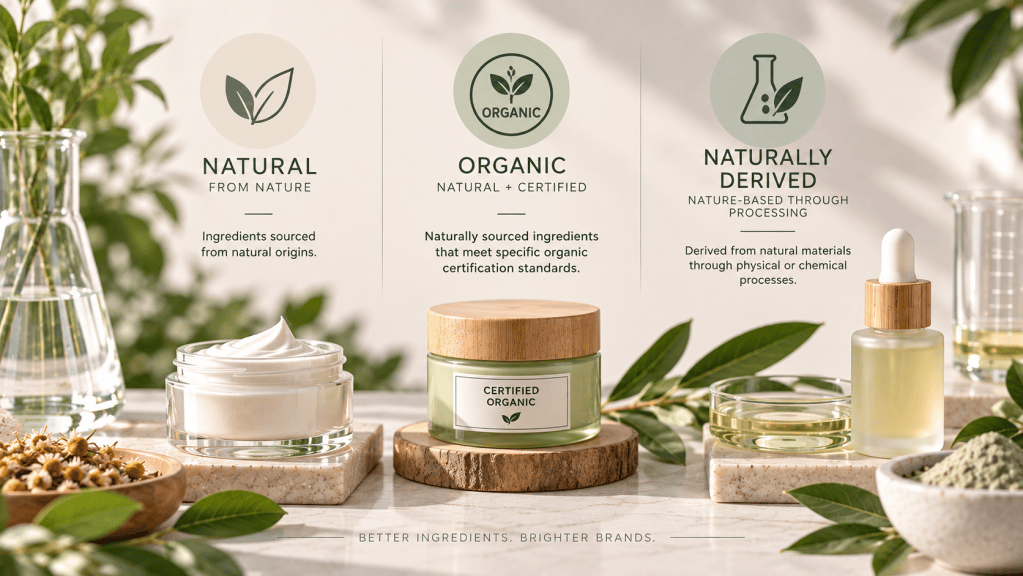
Natural, organic and naturally derived are often used as if they mean the same thing. For product developers, however, they describe different concepts and can lead to very different sourcing, formulation, certification and labeling decisions.
That distinction matters before a formula reaches the packaging stage. A brand that wants a USDA organic claim, for example, needs to plan around formal National Organic Program requirements. A brand using a broader natural-positioning strategy may have more flexibility, but it still needs defensible ingredient documentation and truthful labeling.
For teams comparing natural vs organic cosmetics, the most useful question is not which term sounds better. It is what the intended claim requires from the formula, supply chain, documentation and finished-product positioning.
| Term | What It Generally Describes | Regulatory / Standards Context | Product-Development Impact |
|---|---|---|---|
| Natural | Ingredients or products positioned as coming from natural sources. | FDA has not established a regulatory definition of “natural” for cosmetic labeling. | Brands need their own clear sourcing criteria and evidence for any natural-positioning claim. |
| Organic | Agricultural ingredients or products that meet applicable USDA National Organic Program requirements when making qualifying organic claims. | USDA regulates “organic” for agricultural products and provides certification and labeling categories. | Ingredient sourcing, handling, certification and label language may need to be planned from the start. |
| Naturally derived | Ingredients that originate from natural feedstocks but may be processed before use in the finished formula. | ISO 16128 provides a technical framework for natural/natural-origin ingredient definitions and indexes, but it does not govern claims or labeling. | Brands should define what level and type of processing fits their positioning and supplier criteria. |
The practical takeaway: a natural-positioned formula is not automatically organic, and an ingredient can be naturally derived without being minimally processed or USDA organic.
In the United States, FDA has not established a regulatory definition for “natural” in cosmetic labeling. FDA explains this directly in its cosmetics guidance, which means brands should not treat the term as a government-backed certification by default.
That does not make “natural” meaningless. It means the brand must define what the claim means within its own product-development and substantiation framework. For example, a brand may establish internal rules covering:
The more specific the marketing claim becomes, the more important it is to make sure the formula and supplier records actually support it.
Organic claims follow a different path. FDA does not define “organic” for cosmetics; the USDA National Organic Program regulates the term as it applies to qualifying agricultural products and ingredients.
If a cosmetic contains agricultural ingredients and meets the applicable USDA organic production, handling, processing, certification and labeling requirements, it may be eligible for NOP certification. That makes organic positioning a supply-chain and documentation decision as much as a formulation decision.
For certified products, USDA organic labeling generally falls into four categories based on organic content and other requirements:
| Category | General Threshold | Typical Labeling Implication |
|---|---|---|
| 100 percent organic | All qualifying ingredients are certified organic, excluding water and salt where applicable. | May use the USDA Organic seal when requirements are met. |
| Organic | At least 95% certified organic ingredients, excluding water and salt. | May use the USDA Organic seal when requirements are met. |
| Made with organic … | At least 70% certified organic ingredients, excluding water and salt. | May identify specified organic ingredients or food groups; USDA seal is not used for this category. |
| Less than 70% organic ingredients | Below the 70% threshold. | Organic ingredients may generally be identified in the ingredient statement, but the product cannot be presented as certified organic. |
Exact eligibility and labeling depend on the full formulation and certification context, so brands planning an organic claim should confirm requirements with an accredited certifier before final artwork approval.
Naturally derived is useful when a brand wants to describe an ingredient’s origin without implying that it is unprocessed or certified organic. A naturally derived ingredient may start with plant, mineral, microbial or other natural feedstocks and then undergo processing to create a material suitable for cosmetic formulation.
ISO 16128 provides technical definitions and calculation approaches for natural, natural-origin, organic and organic-origin cosmetic ingredients and products. ISO states that ISO 16128 does not address product claims, labeling or regulatory requirements. In other words, it can help structure technical definitions and origin calculations, but it is not a substitute for a legal or certification review of the finished claim.
For product-development teams, this distinction is important because “naturally derived” can cover a wider range of usable cosmetic materials than a strict minimally processed standard. The brand still needs to define its own claim criteria and confirm that marketing language is supportable.
A positioning decision can influence the formula long before a label is designed. The following areas should be reviewed early.
Organic positioning may require certified agricultural inputs and an eligible certified supply chain. Natural positioning may instead depend on supplier declarations, processing information and origin documentation.
A natural-positioned formula still needs adequate microbiological protection. Limiting preservative options without considering the water phase, packaging, pH and expected consumer use can make formulation more difficult.
Botanical oils, extracts and other naturally sourced materials may vary in color, odor or composition from lot to lot. Product specifications should account for realistic raw-material variation without accepting uncontrolled inconsistency.
Plant oils, extracts and other oxidation-sensitive materials may require antioxidant strategy, appropriate processing conditions and protective packaging. “Natural” does not remove the need for stability work.
Replacing a conventional emulsifier, polymer, silicone or preservative solely to fit a positioning claim can change slip, cushion, absorption, viscosity and rinse-off behavior. The target sensory profile should be part of the brief.
The formula and packaging should be evaluated together. Oils, essential oils, high botanical loads or low-viscosity systems can interact differently with pumps, liners, tubes or airless components.
Ingredient origin should not be used as a shortcut for safety. FDA notes that natural or organic sourcing does not guarantee a cosmetic is safe, and manufacturers remain responsible for ensuring products are safe under labeled or customary conditions of use.
That means natural cosmetic formulation still requires appropriate technical review. Depending on the product, this may include raw-material review, stability work, microbiological controls, preservative-effectiveness testing where appropriate, packaging compatibility, and finished-product specifications.
Instead of beginning with a broad request such as “make this clean and natural,” give the formulation team criteria that can actually guide ingredient selection and development.
| Brief Element | Questions to Answer |
|---|---|
| Claim goal | Natural, naturally derived, USDA organic, “made with organic …”, or another clearly defined positioning? |
| Target market | Where will the product be sold, and which labeling/certification rules apply? |
| Ingredient criteria | Which sources or processing methods are required, preferred or excluded? |
| Certification goal | Is third-party organic or natural certification required? |
| Product format | Cream, serum, balm, cleanser, oil, scrub or another format? |
| Performance target | What texture, finish, fragrance profile and user experience must the formula deliver? |
| Packaging | Which component type is planned, and does the formulation need airless, opaque or other protective packaging? |
| Testing | What safety, stability, compatibility and microbiological work is appropriate for the product? |
Brands researching the broader movement toward organic and natural cosmetics can use that trend context to define where they want to compete. The next step is translating that positioning into ingredient rules, formulation requirements and documentation.
For brands that want to move from positioning into development, MedPak’s approach to organic private label cosmetics formulation provides additional context on formulation planning and production support.
☐ Define exactly what “natural,” “naturally derived,” or “organic” will mean for the product.
☐ Confirm whether a USDA organic certification or another third-party standard is part of the goal.
☐ Set ingredient-origin and processing criteria before formula development begins.
☐ Collect supplier documentation that supports ingredient source and certification status.
☐ Review preservation, pH and microbiological risk without assuming natural origin makes a product self-preserving.
☐ Define acceptable color, odor and viscosity variation for naturally sourced raw materials.
☐ Plan stability and packaging-compatibility work for the finished formula.
☐ Review label wording against the actual certification status and organic-content category.
☐ Avoid implying that natural or organic automatically means safer, non-allergenic or more effective.
☐ Have final claims and artwork reviewed before commercial production.
FDA does not provide a general natural-cosmetics certification. A brand should be able to explain and substantiate what its natural claim means.
An organic claim can create sourcing, certification, handling and labeling obligations that are difficult to retrofit after the formula is finished.
Many natural-origin cosmetic ingredients undergo extraction, purification, fermentation, esterification or other processing before use.
Natural and organic ingredients can still irritate, oxidize, support microbial growth or create allergen concerns. Safety must be assessed for the actual finished product.
Replacing functional ingredients without accounting for preservation, stability, rheology or sensory effects can reduce product performance.
No. “Natural” is a broad positioning term without an FDA regulatory definition for cosmetics, while qualifying organic claims are governed through USDA’s National Organic Program for agricultural products and ingredients.
It generally describes ingredients that originate from natural feedstocks but may undergo processing before use. The exact criteria depend on the standard or brand framework being used.
No. FDA has not established a regulatory definition for “natural” in cosmetic labeling and does not provide a general natural-cosmetics certification.
Potentially, if the product and relevant operations meet applicable National Organic Program requirements and the product qualifies for a labeling category that permits the seal.
No. FDA states that ingredient source does not determine safety. Cosmetic companies remain responsible for ensuring the finished product is safe under labeled or customary conditions of use.
Yes, ideally. Early decisions help the development team choose eligible ingredients, suppliers, handling procedures and documentation that align with the intended claim.
Natural, organic and naturally derived positioning can all work, but they should be treated as product-development requirements rather than decorative language added at the end of the project.
When the claim strategy is decided early, formulation teams can make better choices about ingredients, preservation, certification, supplier documentation, packaging and testing. The result is a product whose positioning is easier to explain, substantiate and scale.
Planning a natural- or organic-positioned skincare product? Contact MedPak Solutions to discuss your product concept, formulation requirements and manufacturing plan.