
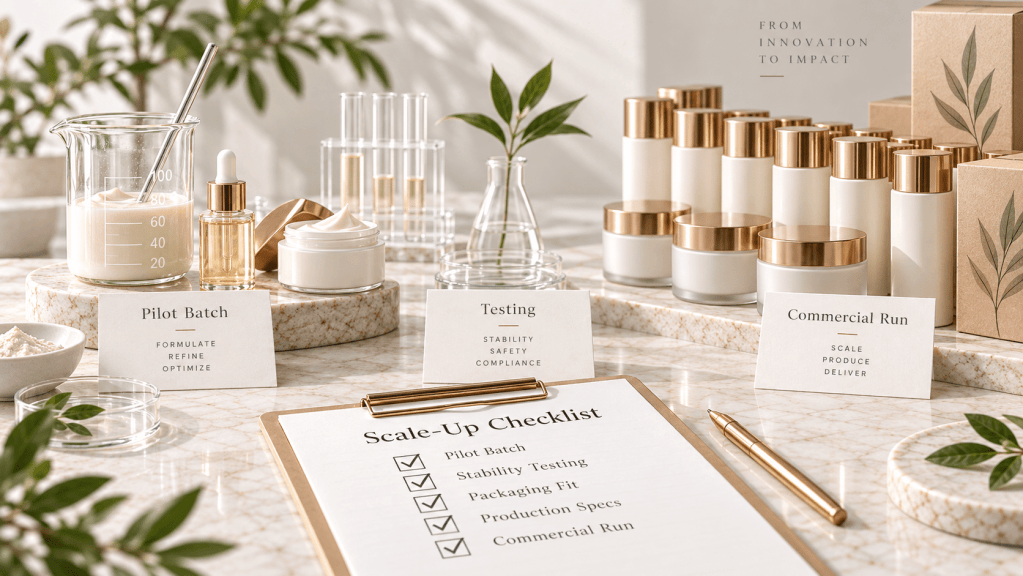
Pilot Batch to Commercial Run:
A Cosmetic Manufacturing Scale-Up Checklist
A successful pilot batch is an important milestone, but it does not automatically mean a formula is ready for commercial production. Cosmetic manufacturing scale up requires a controlled transfer from the development environment to larger equipment, larger raw-material quantities, production documentation, quality checks and the final filling process.
The challenge is not simply making more product. The goal is to reproduce the approved formula as consistently as possible when vessel size, mixing conditions, heating and cooling behavior, transfer steps and filling equipment change.
For beauty brands preparing for a first commercial run, the following checklist helps organize the decisions that should be addressed before, during and after scale-up.
| Key takeawaysLock the formula and finished-product specifications before scaling.Translate the pilot process into documented commercial process parameters.Confirm raw-material, packaging and equipment readiness before the production date.Define in-process and finished-product quality checks before the batch begins.Review the first commercial run as a learning batch and update manufacturing instructions when justified. |
What Changes When a Cosmetic Formula Moves to Commercial Scale?
A laboratory or pilot batch is produced under conditions that are often very different from a full commercial run. The formula percentages may remain the same, but the physical process used to create the product can change significantly.
Larger vessels can alter how ingredients circulate, how quickly the batch reaches temperature, how efficiently powders hydrate, how much air becomes incorporated and how long the product takes to cool. Those differences can affect texture, viscosity, appearance, uniformity and filling behavior.
This is why scale-up should be managed as a manufacturing-transfer stage rather than a simple multiplication exercise. A qualified cosmetic product manufacturing company can help translate development work into the process controls, production records and equipment requirements needed for a larger batch.
1. Lock the Formula and Product Specifications
Start with one approved version of the formula. Making repeated ingredient changes during scale-up creates unnecessary variables and makes troubleshooting harder if the commercial batch behaves differently from the pilot.
Before production planning moves forward, confirm:
- Ingredient identity, grade and percentage
- Approved supplier or material specification where applicable
- Target pH range
- Target viscosity or rheology specification
- Appearance, color and odor specifications
- Finished-product fill requirements
- Any temperature-sensitive or order-of-addition requirements
If an ingredient source, grade or processing aid changes, evaluate that change rather than assuming the commercial batch will behave exactly like the development batch.
2. Capture the Pilot Process Before You Change the Scale
The pilot batch should provide more than a sample of the finished product. It should also provide a documented process that can be evaluated for transfer to production equipment.
Record the conditions that contributed to the successful pilot batch, including:
- Order of ingredient addition
- Mixing and homogenization stages
- Approximate mixing durations
- Heating and cooling targets
- Phase-combination temperatures for emulsions
- When pH adjustments were made
- When fragrance, preservatives or heat-sensitive ingredients were added
- Any hold times or observations that affected the finished texture
These details become the reference point for the scale-up batch. They do not have to be copied mechanically, but they should be understood before commercial parameters are set.
3. Identify the Critical Process Parameters
Some production variables have a much greater effect on the finished product than others. The scale-up plan should identify those variables in advance and define how they will be monitored.
Mixing and shear
A small mixer and a commercial vessel do not create identical flow patterns. Creams, lotions, gels and suspensions may require careful control of mixing speed, impeller selection, homogenization and batch movement to achieve the intended consistency.
Heating and cooling
A larger mass usually heats and cools differently from a pilot batch. Cooling rate can influence viscosity development, crystallization, emulsion structure and the point at which temperature-sensitive materials can be added.
Order of addition
Changing the sequence of additions for convenience can alter hydration, dispersion or emulsion performance. The commercial procedure should preserve the functional logic of the approved development process.
Processing time
Commercial equipment may require different mixing, recirculation or cooling times. Set those times based on process behavior and quality targets rather than assuming the pilot duration should remain unchanged.
4. Confirm Raw-Material Readiness
A scale-up batch requires substantially more raw material than a pilot run, so supply readiness should be confirmed before the manufacturing date is booked.
Review:
- Available quantities and lead times
- Lot identification and control status
- Storage requirements
- Material specifications and supplier documentation
- Approved substitutions, if any
- Potential differences between development-size and production-size material lots
Raw materials that strongly influence viscosity, emulsion structure, fragrance, color or preservation deserve particular attention because even apparently small material differences can become more visible at scale.
5. Define Quality Checks Before the Batch Starts
Quality control should be planned before manufacturing begins, not added after a problem appears. Clear acceptance criteria make it easier to determine whether the scale-up batch matches the approved product standard.
Depending on the formula, in-process or finished-product checks may include:
- Appearance and uniformity
- Color and odor
- pH
- Viscosity
- Specific gravity or density
- Fill weight or volume
- Microbiological specifications
- Packaging and dispensing performance
The U.S. Food and Drug Administration’s Good Manufacturing Practice (GMP) Guidelines/Inspection Checklist for Cosmetics highlights written production instructions, in-process controls, raw-material controls, laboratory checks and batch records as important areas of cosmetic manufacturing control. FDA states that rigorous adherence to good manufacturing practice helps minimize the risk of adulteration or misbranding.
For a scale-up batch, the practical takeaway is simple: decide what “acceptable” means before production begins, then record the results against those specifications.
6. Plan Packaging and Filling as Part of Scale-Up
A formula can perform well in the manufacturing vessel and still create problems during filling. Packaging should therefore be part of the scale-up plan rather than a separate decision made after the bulk is finished.
Check the relationship between the formula and the selected package, including:
- Viscosity and pump or dispenser performance
- Filling temperature
- Tube, jar or bottle opening size
- Closure fit and leak resistance
- Product transfer through pumps, hoses or filling lines
- Air entrapment during filling
- Label and component readiness
- Any known packaging compatibility concerns
For example, a cream that is easy to fill at pilot scale may require different transfer or filling conditions when the bulk quantity increases. Packaging problems discovered before a full run are usually easier to solve than problems found after thousands of components are committed.
7. Build the Commercial Production Plan Around Dependencies
Effective cosmetic production planning coordinates formula readiness, raw materials, packaging, testing and manufacturing capacity so that one missing component does not delay the entire run.
Before scheduling commercial cosmetic production, confirm:
- Approved formula and manufacturing instructions
- Raw-material availability
- Primary packaging and closures
- Labels or decoration components
- Planned batch size and expected yield
- Required in-process and finished-product testing
- Filling setup and packaging configuration
- Batch coding and recordkeeping requirements
- Release criteria before finished goods move to the next stage
Brands should also look beyond the immediate batch and confirm that the manufacturer has the appropriate skin care manufacturing capabilities for the formulation, equipment and filling format being planned. Matching product requirements to manufacturing capability early can reduce avoidable changes later in the project.
8. Treat the Scale-Up Batch as a Controlled Learning Run
Even with strong preparation, the first larger batch can reveal information that was not visible at pilot scale. The production team should capture those observations instead of relying only on whether the final product passed or failed.
Useful records include:
- Actual heating and cooling times
- Mixing or homogenization adjustments
- In-process pH and viscosity observations
- Yield and material losses during transfer
- Filling speed and fill consistency
- Any foaming, air incorporation or settling observed
- Deviations from the planned process and the reason for each change
If the batch needs an adjustment, document what changed and why. Those records make the next production run more repeatable and help distinguish a one-time production issue from a process parameter that should be formally revised.
9. Review the First Commercial Run Before Routine Production
The first full production run should close with a structured review. This is where development knowledge becomes a more mature commercial manufacturing process.
Ask:
- Did the batch meet all approved specifications?
- Were the planned process parameters practical on commercial equipment?
- Did viscosity and texture develop as expected?
- Did the product transfer and fill efficiently?
- Were there unexpected losses or yield differences?
- Did packaging perform as expected?
- Were any deviations, rework steps or adjustments required?
- Should the master manufacturing instructions be updated before the next run?
A commercial run is successful not only when the finished batch looks right, but when the process is documented well enough to support consistent future production.
Cosmetic Manufacturing Scale-Up Checklist
Use this condensed checklist before approving a pilot formula for its first larger manufacturing run.
| Area | What to confirm |
| Formula readiness | Approved master formula; raw-material specifications; target pH/viscosity; appearance and sensory specifications. |
| Process transfer | Order of addition; mixing/shear; heating/cooling; hold times; critical process parameters documented. |
| Materials | Production quantities available; lots identified; supplier documents reviewed; substitutions controlled. |
| Quality controls | In-process checks and finished-product specifications defined before production. |
| Testing | Appropriate stability, microbiological and preservation considerations reviewed for the product. |
| Packaging | Container, closure, dispensing and filling compatibility assessed. |
| Production plan | Batch size, expected yield, equipment, filling setup, coding and release requirements confirmed. |
| Post-run review | Actual process data, deviations, yield, filling performance and improvement actions documented. |
Common Scale-Up Problems to Watch For
Scale-up issues vary by product, but several patterns are common enough to plan for in advance.
Unexpected viscosity changes
Differences in mixing, cooling rate, hydration or shear can make a larger batch thicker or thinner than the approved pilot.
Incomplete dispersion
Powders, gums, pigments or other materials may require different addition or mixing strategies in larger equipment.
Air incorporation
A change in mixing geometry or speed can pull excess air into the product and affect appearance, density or filling.
Temperature lag
Larger batches often take longer to heat or cool, which can change when ingredients are added and how the final structure develops.
Filling difficulties
A formula that is stable in bulk can still be difficult to transfer, pump or dispense through the chosen packaging.
Yield differences
Product retained in tanks, hoses, transfer lines or filling equipment can change the usable finished quantity compared with pilot expectations.
Why Scale-Up Should Be Planned Early
The easiest time to solve scale-up problems is before a brand has committed to a large quantity of raw materials, packaging or launch inventory. Manufacturing considerations should therefore be introduced while the formula and package are still being finalized.
Early planning allows the product-development and production teams to evaluate whether the formula, equipment, batch size and package are compatible before a larger investment is at risk. It also gives quality teams time to define specifications and testing requirements rather than reacting to issues after the run.
For growing beauty brands, this approach creates a more reliable bridge between development and repeatable production. A well-planned scale-up batch provides both finished product and the manufacturing knowledge needed for future runs.
From Pilot Success to Repeatable Commercial Production
Moving from a pilot batch to commercial volume is one of the most important transitions in cosmetic product development. The formula is only one part of that transition. Equipment, mixing, temperature control, raw materials, quality specifications, packaging and documentation must work together.
A structured scale-up process reduces guesswork and gives the production team a clear basis for evaluating the first commercial batch. Just as importantly, it creates records that can improve consistency when the product is manufactured again.
If your product is approaching commercial production, MedPak Solutions can help you evaluate manufacturing requirements, production planning and the capabilities needed to move from development into a larger run.
Frequently Asked Questions
What is a scale-up batch in cosmetic manufacturing?
A scale-up batch is a larger manufacturing run used to transfer a formula from development or pilot conditions into commercial equipment. It helps verify process parameters, product specifications, quality checks and filling behavior before routine production.
Why can a cosmetic formula change when batch size increases?
Larger vessels can change mixing patterns, shear, heating and cooling rates, ingredient dispersion and transfer behavior. Those process differences can affect viscosity, texture, appearance and filling performance even when the ingredient percentages remain the same.
Is cosmetic manufacturing scale up just a larger version of the pilot recipe?
No. The master formula remains controlled, but processing conditions may need to be adapted to the commercial equipment. Mixing, homogenization, heating, cooling, hold times and filling conditions should be evaluated rather than copied automatically.
What should be approved before commercial cosmetic production begins?
At minimum, the formula, raw-material requirements, manufacturing procedure, quality specifications, packaging components, testing plan, batch size and release requirements should be clear before the run is scheduled.
What should happen after the first commercial run?
The team should review the batch record, process data, quality results, yield, filling performance and any deviations. Validated improvements can then be incorporated into the manufacturing instructions for future production.