
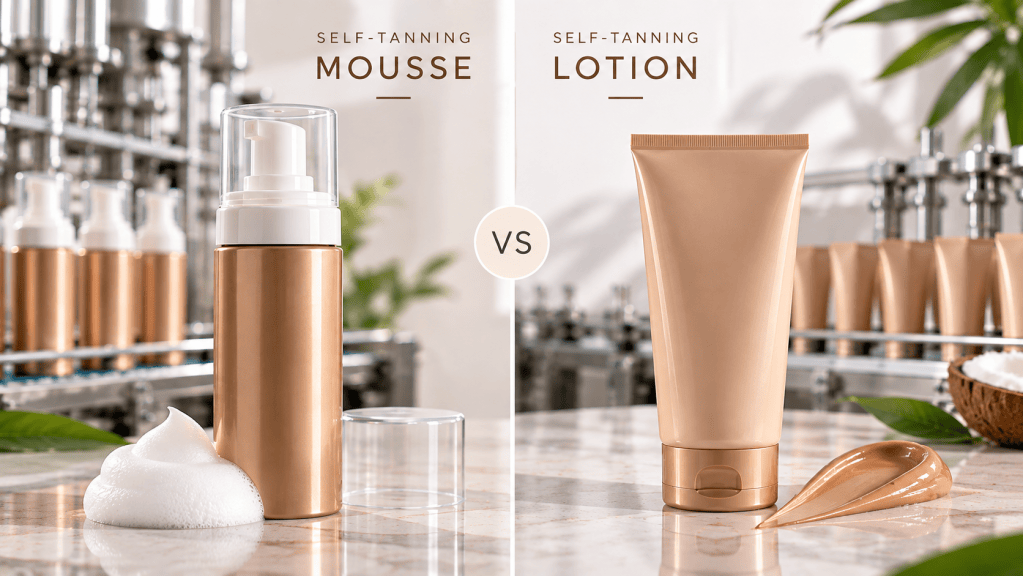
A self-tanning mousse and a self-tanning lotion may use the same headline tanning ingredient, but they create very different manufacturing problems.
The difference is not only texture. Mousse performance depends on the interaction between the liquid formula and the foaming package. Lotion performance depends more heavily on emulsion structure, viscosity, pumpability and how the product behaves during filling and storage.
For brands comparing self tanning mousse vs lotion manufacturing, the decision should therefore be made at the product-development stage—not after the formula has already been finalized.
This guide focuses on packaging, filling, rheology, stability and manufacturing controls. It intentionally avoids a consumer-style comparison of which format tans faster, feels better or produces a darker result.
| Key TakeawaysMousse requires a formula that can pass through a foaming-pump system and create repeatable foam; lotion does not.Lotion viscosity must support emulsion stability and consumer dispensing without becoming too difficult to fill.The final package should be selected and tested with the actual formula, not chosen from appearance alone.DHA stability depends on the complete formulation, including pH, ingredients, storage and packaging conditions.Filling equipment, line speed, air incorporation, headspace and package geometry can affect finished-product quality.The right format is the one the manufacturer can produce, fill and validate consistently at commercial scale. |
From a brand perspective, both formats may sit in the same self-tanning category. From a manufacturing perspective, they are different delivery systems.
A lotion is usually an emulsion or structured liquid that must remain uniform, stable and easy to dispense. A mousse sold in a mechanical foaming package is typically filled as a liquid and transformed into foam by the package during dispensing.
That means the package is part of the mousse’s performance system.
If the liquid is too viscous, contains poorly dispersed solids, or does not interact well with the pump’s mesh and air-mixing design, the finished product may dispense inconsistently even if the bulk formula looks acceptable in the vessel.
| Factor | Self-Tanning Mousse | Self-Tanning Lotion |
| Bulk texture | Low-to-moderate viscosity liquid designed for foam generation | Structured liquid/emulsion with target body and spread |
| Package dependency | Very high: pump geometry and foam engine affect consumer experience | Moderate-to-high: closure, pump/tube/orifice must match viscosity |
| Primary filling concern | Clean, repeatable liquid fill without excessive aeration or pump contamination | Accurate fill despite viscosity, shear history and temperature |
| Stability focus | DHA stability + foamability + liquid uniformity + package performance | DHA stability + emulsion/viscosity stability + package compatibility |
| Common package | Mechanical foaming pump bottle | Pump bottle, squeeze bottle, tube or another compatible lotion package |
| Scale-up concern | Foaming behavior can change if bulk viscosity or surfactant balance shifts | Viscosity may shift with batch scale, mixing, cooling or shear |
With a mechanical foaming pump, the bottle is not simply a container. The pump meters liquid and mixes it with air through internal components to produce foam.
For product development, the brand and manufacturer should evaluate:
A formula that foams well through one package may not behave identically in another. For that reason, tanning mousse packaging should be locked only after the formula and package have been evaluated together.
Self-tanning lotion manufacturing usually places greater emphasis on emulsion structure, viscosity and cooling profile.
The manufacturer may need to control:
A lotion can look too thin immediately after production and develop final viscosity later, or appear acceptable in the tank and change after filling. That is why viscosity targets should be tied to a defined measurement method, temperature and timing.
Dihydroxyacetone (DHA) is commonly used in sunless tanning cosmetics to create visible color on the skin.
FDA authorizes DHA as a color additive for external application in cosmetics, subject to the applicable limitations. See FDA’s Sunless Tanners & Bronzers guidance.
DHA is chemically reactive, so formula conditions matter.
Published formulation research on DHA-containing sunless tanners identifies pH as a key stability parameter and also highlights the importance of thickeners and overall formula design. See the PubMed-indexed study on DHA sunless tanning formulation stability.
Brands should avoid turning that into a universal pH prescription. The final target should be established for the complete mousse or lotion formula, including preservation, rheology, package and intended use.
A mousse needs enough body to remain uniform in the bottle but still flow through the foaming mechanism.
If the bulk is too thin, the product may feel watery, settle unevenly or generate weak foam depending on the system. If it is too thick, the pump may struggle to meter the liquid or create consistent foam.
Mousse development should therefore evaluate viscosity together with:
The correct viscosity is a package-specific performance range, not simply a sensory target.
For lotion, viscosity has a different job.
It contributes to product body, suspension, sensory feel and emulsion stability, but it also determines how easily the product moves through pumps, hoses and filling nozzles.
If viscosity is too high:
If viscosity is too low, the product may not match the desired sensory profile and may indicate an unstable or under-structured formula.
The target should therefore be selected with both consumer experience and production equipment in mind.
Foam is desirable when a mousse is dispensed, but uncontrolled air inside the bulk during manufacturing or filling is not the same thing.
For lotions, excessive aeration can also create filling and appearance problems, especially in opaque or viscous emulsions.
Manufacturing procedures may need to control mixer position, shear, recirculation, deaeration or hold time before filling depending on the formula.
Tanning product filling should be considered while the formula is still under development.
For mousse, the manufacturing team should confirm that the liquid can be filled cleanly into the chosen foaming package and that the pump components remain functional after assembly.
For lotion, filling compatibility may depend on:
Commercial filling trials can reveal issues that are not visible in a small lab sample.
A package that looks right on a packaging supplier’s sample table may not be compatible with the final tanning formula.
Because self-tanning products can develop color through DHA chemistry, visible changes at the package interface deserve particular attention during stability work.
Both mousse and lotion are commonly water-containing systems, so microbiological quality and preservation need to be addressed.
The same preservative approach should not automatically be assumed to work in every mousse and every lotion. Finished-product microbiological and preservative-performance testing should be appropriate to the formula and package.
A stability program for a self-tanning product should track more than color development.
For mousse, review:
For lotion, review:
The package should remain part of the stability program because the consumer experiences the formula through the dispensing system.
Brands should decide whether they are building a mousse or lotion concept before final supplier selection because not every manufacturer uses the same filling equipment or package systems.
MedPak’s comparison of tanning mousse vs tanning cream suppliers can help brands think through format selection at a higher level.
Brands evaluating wholesale tanning lotion suppliers should look beyond a sample’s texture or color and ask how the formula is controlled in production, filled, tested and packaged.
For lotion in particular, repeatable viscosity, stable emulsification and compatible dispensing should be part of the manufacturing conversation—not assumptions made after the product is ordered.
| Product Goal | Likely Direction | Technical Priority |
| Brand wants a light foamed application | Mousse | Foam-pump compatibility, viscosity window, foam consistency |
| Brand wants a richer skincare-like texture | Lotion | Emulsion stability, viscosity, pump/tube compatibility |
| Package is already chosen | Either, but validate carefully | Confirm formula can work with the selected dispensing architecture |
| Formula contains many oils/emollients | Often lotion is easier, but not automatic | Emulsion system and foaming impact need review |
| Fast filling on conventional lotion equipment is a priority | Lotion may be simpler | Confirm viscosity and nozzle/filler fit |
| Distinct modern foam experience is core to positioning | Mousse | Treat package + formula as one engineered system |
☐ Product format locked: mousse or lotion
☐ DHA raw-material specification reviewed
☐ Target pH established for the complete formula
☐ Rheology/viscosity target documented
☐ Preservative strategy defined
☐ Foaming-pump system selected and evaluated for mousse
☐ Pump/tube/bottle compatibility reviewed for lotion
☐ Filling method confirmed
☐ Target fill weight and package headspace defined
☐ Bulk aeration risk reviewed
☐ Stability plan includes the final package
☐ Microbiological testing plan established
☐ Pump or foamer performance added to finished-product checks
☐ Label does not imply UV protection unless separately compliant
☐ Commercial-scale trial or first-run monitoring plan defined
Self-tanning products create cosmetic color. That does not mean they provide sunscreen protection.
FDA states that sunless tanning products containing DHA do not inherently protect consumers from ultraviolet radiation. Tanning products without sunscreen are subject to a required warning explaining that they do not protect against sunburn. See FDA’s required warning statement for tanning products without sunscreen.
Brands should therefore avoid wording that suggests a mousse or lotion is a safer substitute for sunscreen or creates a protective tan.
Self-tanning mousse and lotion can both support strong product concepts, but the manufacturing pathway is different.
Mousse requires the liquid formula, pump geometry and air-mixing system to work together. Lotion requires reliable emulsion structure, viscosity control and dispensing compatibility.
For brands, the most important question is not which format sounds more premium. It is whether the formula can be manufactured, filled, packaged and tested consistently in the format selected.
Making that decision early reduces reformulation, package changes and filling surprises as the product moves from lab sample to commercial run.
| Developing a self-tanning mousse or lotion?MedPak Solutions can help evaluate formulation requirements, packaging compatibility, filling considerations and commercial production planning for your tanning product.Contact MedPak Solutions |
Yes. A mousse is generally filled as a liquid into a foaming package, so the liquid’s viscosity and foamability must work with the pump. Lotion manufacturing places greater emphasis on emulsion structure, viscosity development and conventional pump, bottle or tube dispensing.
The foaming pump creates the mousse at the moment of dispensing. Pump geometry, mesh, dose and air mixing interact with the liquid formula, so the package is part of the product’s functional performance.
Usually not without evaluation or reformulation. The viscosity, surfactant system, emulsion structure and package requirements for a lotion may not be compatible with a foaming pump.
DHA stability depends on the complete formulation, including pH, ingredient interactions, storage and package conditions. Brands should avoid relying on one universal pH rule and instead validate the finished formula.
Not necessarily. Many mousse products use mechanical foaming pumps that mix liquid with air during dispensing. Package selection should match the formula and intended manufacturing process.
Not inherently. FDA states that DHA-based sunless tanning products do not by themselves provide UV protection. Products should not imply sunscreen benefits unless they separately meet the applicable requirements.