
How Does Sorbitan Oleate Improve Skincare Product Performance?
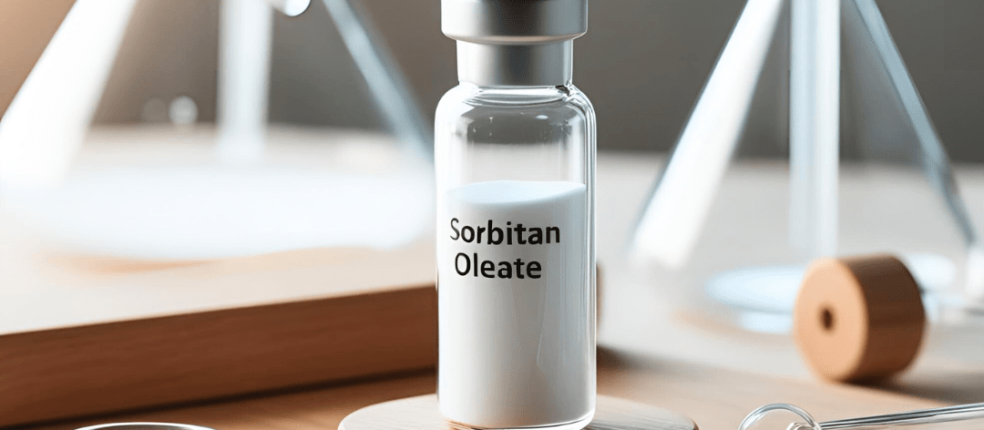
Sorbitan Oleate is an important emulsifier in skincare to make sure oil and water blend seamlessly in creams, lotions, and serums.
Sourced from vegetable-based raw materials, this ingredient stabilizes formulations, improves texture, and enhances the even dispersion of pigments and sunscreen agents like titanium dioxide and zinc oxide.
But beyond emulsification, how does it interact with the dermal layers?
What benefits does it bring beyond stability?
What is Sorbitan Oleate?
Sorbitan Oleate is commonly referred to as Span 80 because it belongs to the Span series of nonionic surfactants. The “Span” designation is used for sorbitan-based emulsifiers, while 80 represents the oleate (oleic acid) ester of sorbitan.
This nonionic emulsifier, derived from plant-based sources, is commonly used in cosmetic formulations to stabilize water-in-oil (W/O) emulsions.
It is a PEG-free ingredient with an HLB (Hydrophilic-Lipophilic Balance) value of 4.3, which makes it highly effective in formulations that require prolonged stability. The primary function is to facilitate the blending of oil and water phases to achieve a uniform texture and consistent product performance.
Technical Data
INCI Name | Sorbitan Oleate |
INCI Designation | [(2R)-2-[(2R,3R,4S)-3,4-dihydroxyoxolan-2-yl]-2-hydroxyethyl] (Z)-octadec-9-enoate Sorbitan monooleate |
Synonyms | SPAN 80, Sorbitan monooleate, Sorbitan, mono-9-octadecenoate, and (Z)- |
CAS Number | 1338-43-8 |
Formula | C24 H44 O6 |
Chemical Classification | Sorbitan Derivative |
Category (Functional) | Surfactant ~ Emulsifier |
Other Features | Vegan, Cruelty-free, Non-GMO |
How is Sorbitan Oleate Made?
This ingredient is obtained through the condensation reaction of sorbitol—a sugar alcohol—with oleic acid, an unsaturated fatty acid. The resulting molecule consists of a sorbitan segment (which exhibits mild hydrophilic properties) and an oleic acid segment (which is highly lipophilic).
The dual affinity lets SPAN 80 functions as a surfactant to improve the spreadability of emulsions and aid in the dispersion of insoluble particles, like pigments, and inorganic UV filters, like titanium dioxide and zinc oxide. Visually, it appears as a yellow to brown viscous liquid.
Primary Function in Cosmetic Formulations

SPAN 80 can be combined with high-HLB emulsifiers, such as polysorbates, to create stable oil-in-water (O/W) emulsions. It is compatible with a wide range of natural, mineral, and synthetic oils. So, it’s really a versatile component in private-label cosmetics and skincare formulations.
Its mild nature makes it especially suitable for products targeting sensitive skin. Besides, its ability to function in cold-process formulations helps preserve the stability of heat-sensitive active ingredients.
Key Benefits
Hydration Support
SPAN 80 contributes to dermal hydration by improving the water retention capacity of emulsions. Its ability to stabilize oil and water phases makes moisture remain evenly distributed throughout a product to prevent separation and evaporation.
- Maintains hydration in a cosmetic formulation by supporting a uniform dispersion of water molecules.
- Enhances the penetration of moisturizing ingredients into deeper dermal layers.
- Provides a smooth, non-greasy application for long-lasting hydration.
Emulsification
It allows water and oil to mix into a stable formulation. This is important for products like creams, lotions, and serums that require a consistent texture and extended shelf life.
- Works effectively as a co-emulsifier when combined with high-HLB emulsifiers such as polysorbates.
- Increases product stability to keep the formulation intact over time.
Texture Enhancement
The presence of SPAN 80 contributes to the sensory experience of skincare products by creating a smooth, non-sticky texture. It affects the overall feel of emulsions and makes them more pleasant to apply.
- Produces a creamy, well-blended texture in emulsified products.
- Improves the spreadability of lotions and serums for an even application.
- Enhances the overall consistency to prevent clumping or separation of ingredients.
Dermal Conditioning
Beyond emulsification, it has conditioning effects that improve a product’s interaction with the epidermis. It softens and smooths the dermal surface, which makes it a beneficial ingredient in moisturizers and other leave-on formulations.
- Contributes to a soft, supple skin feel without a heavy residue.
- Works well in sensitive derm formulations due to its mild, non-irritating nature.
- Aids in the delivery of active ingredients by improving ingredient dispersion across the dermal surface.
Skincare Brands Are Choosing Sorbitan Oleate for Superior Emulsification

On the Skin Barrier
SPAN 80 helps maintain the derm’s moisture balance. It helps form water-in-oil emulsions, which protect the skin by reducing water loss. This improves hydration and toughens the derm’s natural barrier without creating a greasy feel.
Unlike harsher surfactants (e.g., sodium lauryl sulfate), it lets the skin retain its natural moisture to make it soft and smooth.
Evenly distributes active ingredients (e.g., oxybenzone, octinoxate, octisalate, and avobenzone) in products like sunscreens and makeup to improve overall product performance and stability. Its gentle, heat-free formulation process also helps preserve the effectiveness of sensitive ingredients.
On Hair Fibers
Beneficial for even oil distribution and conditioning in hair care products. SPAN 80 helps spread nourishing ingredients throughout the scalp and hair for a consistent treatment.
When used in shampoos, it stimulates even cleansing, while in conditioners, it softens the hair cuticle to improve manageability and reduce tangling.
Is Sorbitan Oleate Safe?
Yes, Sorbitan Oleate is considered safe for use in cosmetics. It is mild and effective in moisturizing and emulsifying products. It works well for normal, dry, and combination skin.
On Hair Fibers
Yes, Sorbitan Oleate is considered safe for use in cosmetics. It is mild and effective in moisturizing and emulsifying products. It works well for normal, dry, and combination skin.
Precautions: Potential Sorbitan Oleate Side Effects
- Patch Testing: Do a patch test before applying products with SPAN 80, especially for those with sensitive skin. Apply a small amount to an inconspicuous area, like your wrist, and wait 24-48 hours to check for irritation.
- Concentration Levels: Cosmetic product manufacturer uses SPAN 80 in low concentrations (2-10%) to reduce the risk of irritation. Higher concentrations may cause irritation.
- Eye Contact: Avoid contact with the eyes. If it happens, rinse immediately with water.
- Storage: Store products with SPAN 80 in a cool, dry place to maintain effectiveness.
Achieve Superior Product Stability with Medpak Solutions
Sorbitan is an emulsifier that boosts the effectiveness of cosmetic products. Cosmeceutical companies rely on it for stable, high-performance formulas. The beauty industry embraces new skincare trends, and this natural emulsifier optimizes formulation stability, texture, and pigment dispersion.
Frequently Asked Questions
Is sorbitan oleate comedogenic?
No, it is generally considered non-comedogenic. This means it does not clog pores and is unlikely to cause breakouts on most derm types.
Is sorbitan oleate good for skin?
It offers several benefits in skincare. Since it’s made from sorbitol and oleic acid, it acts as an emulsifier and has emollient properties that moisturize and soften the epidermis to make it smooth and supple.
Is SPAN 80 safe?
Yes, it’s safe even in food. The FDA has approved it as Generally Recognized as Safe (GRAS) for use in both foods and cosmetics.
Is sorbitan oleate the same as polysorbate 80?
They are similar but not the same. Both are emulsifiers, but the former is a sorbitan derivative, while the latter is a polyethylene glycol (PEG) derivative. Sorbitan is more hydrophobic, whereas Polysorbate is more hydrophilic, which affects their formulation uses.