
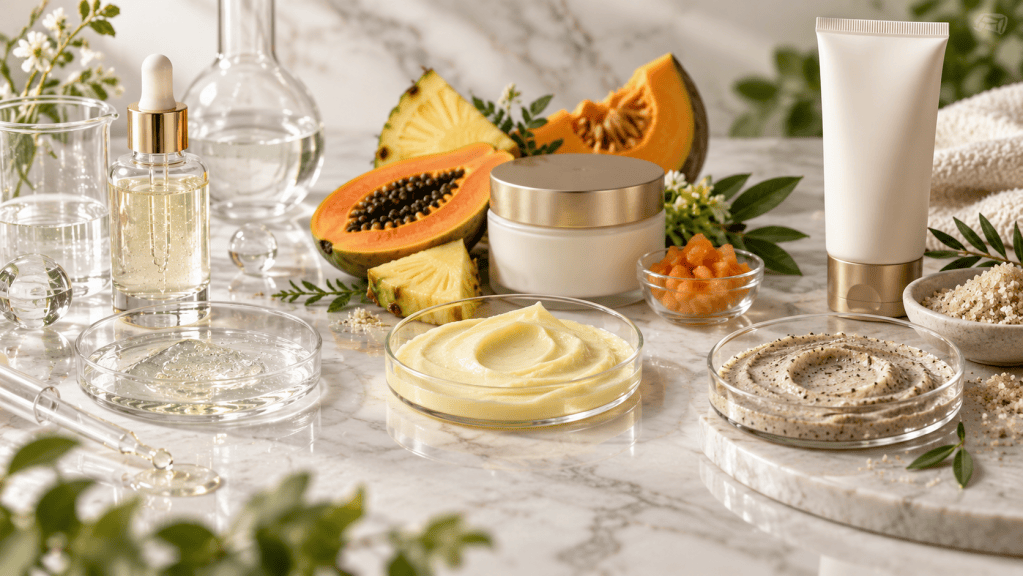
An exfoliating face mask can be built around very different mechanisms. One formula may use alpha-hydroxy acids (AHAs) to loosen surface cell cohesion, another may use proteolytic enzymes, while another relies on suspended particles that create mechanical exfoliation during massage and rinse-off.
Those systems are not interchangeable.
Each approach affects pH, stability, texture, processing, packaging, consumer instructions and irritation risk differently. A successful exfoliating face mask formulation therefore starts with the product brief and intended use experience—not with a decision that one exfoliation method is universally better than another.
This guide compares AHA, enzyme and physical exfoliation systems from a formulation perspective so beauty brands can choose a direction that fits the product concept, target user and manufacturing requirements.
| Key TakeawaysAHA masks depend heavily on acid type, concentration, final pH and the rest of the formula.Enzyme systems require attention to pH, temperature, stabilization and potential irritation or allergen concerns.Physical exfoliation depends on particle shape, size, hardness, concentration and the amount of friction created during use.Combination systems can work, but stacking exfoliation mechanisms increases formulation and tolerability complexity.The best choice is the one that matches the product brief, target user, use time, rinse-off behavior, packaging and claim plan. |
Before selecting an exfoliating system, define what the mask should feel like and what the consumer should experience.
A useful product brief can specify:
That brief creates the decision criteria for the exfoliation system. A five-minute gel mask intended for frequent use has different needs from a rich clay mask designed for occasional use.
| System | How It Works | Key Formulation Controls | Potential Advantage | Primary Watchouts |
| AHA | Chemical exfoliation using acids such as glycolic or lactic acid | Final pH, acid concentration, buffering, preservation, compatibility, sun-sensitivity labeling | Controlled formula design; no particulate feel | Irritation potential; pH constraints; stronger regulatory/labeling considerations |
| Enzyme | Proteolytic enzymes help break down protein at the skin surface | Enzyme identity, activity, pH, temperature, stabilization, water activity and preservation | Can support a non-gritty exfoliation story | Activity can decline in formula; enzyme stability and sensitization/irritation require review |
| Physical | Particles create mechanical friction during massage or rinse-off | Particle size, shape, hardness, loading, suspension, settling and package dispensing | Immediate tactile exfoliation; easy-to-understand consumer experience | Too much friction or unsuitable particles can increase irritation; settling and uneven distribution can occur |
AHAs are commonly used in cosmetic exfoliation because they can increase shedding of surface skin cells. The formulation challenge is that their behavior depends on more than the percentage printed in a product brief.
FDA explains that the extent of AHA exfoliation depends on the type and concentration of the AHA, the product’s pH and other ingredients in the formula.
That makes an AHA face mask formulation a complete system-design problem.
Glycolic acid and lactic acid are two common AHAs, but formulators should not assume that using the same percentage of each produces an identical product.
Selection can affect:
A lower pH can increase the proportion of acid present in its free form, but it can also increase tolerability concerns and complicate other parts of the formulation.
For consumer cosmetics containing glycolic or lactic acid, FDA summarizes a Cosmetic Ingredient Review conclusion that these AHAs are safe under defined conditions, including concentration and final-pH limits, alongside measures addressing increased sun sensitivity.
That does not mean every face mask should be formulated at the limit. A formulator should establish the product-specific target based on the complete formula, intended use time, frequency and testing.
FDA recommends a sunburn-alert statement for topical cosmetics containing AHAs because use may increase skin sensitivity to the sun.
For a face mask, instructions should also make the intended exposure clear: how much product to apply, how long to leave it on, how to rinse it off and how frequently it is intended to be used.
Enzyme exfoliation is attractive because it offers a different product story from acids or gritty scrubs. Proteolytic enzymes such as papain and bromelain have been explored for cosmetic exfoliation.
A peer-reviewed review indexed by PubMed found that enzymes can support exfoliation, but emphasized the importance of pH, temperature and enzyme stabilization in cosmetic formulations, along with possible irritation or allergen considerations.
An enzyme can have useful activity as a raw material and still lose performance after it is added to a finished mask.
The development team may need to review:
This makes supplier technical documentation especially important. “Contains papaya enzyme” is a marketing statement; a commercial formulation also needs a defined ingredient, use level, processing method and stability plan.
Enzyme masks are sometimes positioned as a gentler alternative to acids, but that should not become a universal claim.
Tolerance depends on the enzyme, concentration, formula, contact time and user. A brand should avoid presenting “enzyme” as automatically suitable for every sensitive-skin consumer unless the finished product and claim evidence support that positioning.
Physical exfoliation depends on friction rather than acid dissociation or enzyme activity. The consumer may massage the mask before rinsing, or the particles may provide mild mechanical action during removal.
The performance of a physical exfoliant face mask depends on the particle system, including:
The American Academy of Dermatology notes that mechanical exfoliation can be more irritating for some dry, sensitive or acne-prone skin types and recommends matching exfoliation method to skin type and avoiding overly aggressive exfoliation.
AAD guidance on safely exfoliating at home is a useful consumer-safety reference when drafting use directions.
Particles also create practical formulation challenges.
If the base is too thin, exfoliating particles may settle. If the structure is too thick, the product may become difficult to spread, fill or rinse away.
Formulators may need to balance:
The goal is not to create the roughest scrub. The goal is to achieve the intended exfoliation experience with a particle system that is appropriate for the use instructions.
Brand standards, retailer requirements, sustainability goals and regional restrictions can also influence which particulate exfoliants are suitable.
Yes, hybrid systems are possible, but combining mechanisms should be a deliberate formulation decision.
A mask containing an acid, enzyme and particulate exfoliant may create a compelling “multi-action” concept, but it also introduces more variables:
More exfoliation mechanisms do not automatically create a better mask. The formula still needs to be tolerable, stable and appropriate for its intended use.
Clay masks create another formulation path. Kaolin, bentonite and other clays can change oil absorption, viscosity, drying behavior, color and rinse-off feel.
When building an exfoliating clay mask, review facial mask ingredient sourcing alongside the exfoliation system because the clay base can significantly change the finished use experience.
For example, a highly absorbent or fast-drying clay base paired with an aggressive acid or abrasive system may create a very different tolerability profile from the same exfoliant in a hydrating gel mask.
| Product Brief | Possible Direction | What to Validate |
| Consumer wants a no-grit treatment experience | AHA or enzyme | Choose based on pH tolerance, activity, claim plan and stability. |
| Brand wants a tactile scrub experience | Physical | Control particle properties, friction and suspension. |
| Mask is positioned around clay and deep-cleansing sensory cues | Physical, AHA, enzyme or a restrained combination | Balance absorbency/drying behavior with exfoliation intensity. |
| Target user prioritizes mild-feeling routine use | Potentially lower-intensity acid, enzyme or very mild physical system | Finished-product testing matters; do not assume one class is automatically gentle. |
| Brand wants a multi-action professional-style concept | Hybrid system | Requires the most careful compatibility, tolerability and directions planning. |
The testing plan should reflect what the exfoliating system can change in the formula.
Depending on the product, development may consider:
For AHA products, sun-sensitivity labeling and use directions deserve specific review. For enzymes, activity retention may need attention. For particulate systems, the team should confirm that exfoliant distribution remains uniform through storage and use.
Exfoliation can easily drift into medical-sounding language.
A cosmetic mask may be positioned around appearance and feel, for example:
Claims such as treating acne, removing scars or permanently altering skin structure can trigger a different regulatory analysis.
FDA specifically notes that products marketed to treat acne, remove scars or otherwise treat disease or affect body structure/function may be drugs rather than cosmetics. See the FDA AHA guidance for examples of this distinction.
Once the exfoliation direction has been selected, the next step is to connect the system to the rest of the product: base architecture, preservation, stability, package and commercial production.
MedPak’s guide to exfoliating mask formulation provides the broader formulation context. This article is designed to support that page by helping brands make the earlier decision: which exfoliation mechanism best fits the product brief?
☐ Primary target user defined
☐ Mask format selected
☐ Exfoliation system chosen: AHA, enzyme, physical or hybrid
☐ Target use time and frequency documented
☐ pH requirements reviewed
☐ Ingredient compatibility reviewed
☐ Irritation/tolerability risk considered
☐ Particle suspension reviewed for physical systems
☐ Enzyme stability/activity plan established where relevant
☐ Sun-sensitivity labeling reviewed for AHA systems
☐ Preservation and microbiological plan defined
☐ Packaging and fill method reviewed
☐ Claims kept within cosmetic boundaries
☐ Stability and finished-product testing plan documented
AHA, enzyme and physical exfoliation can all support effective face-mask concepts, but they solve the formulation problem differently.
AHAs bring pH and acid-balance considerations. Enzymes require activity and stabilization planning. Physical exfoliants depend on particle design, suspension and consumer friction.
For beauty brands, the strongest product is not the mask with the greatest number of exfoliating mechanisms. It is the mask whose exfoliation system fits the target user, base formula, packaging, use directions and claim strategy—and remains stable and manufacturable over time.
| Planning an exfoliating or clay face mask?MedPak Solutions can help evaluate formula format, exfoliation system, ingredient compatibility, packaging and commercial manufacturing requirements.Contact MedPak Solutions |
There is no universal best option. AHA, enzyme and physical systems have different pH, stability, sensory and tolerability requirements. The best choice depends on the product brief, target user, mask base, use time and claims.
Formulators should consider the specific acid, concentration, final pH, preservation, other ingredients, contact time and consumer directions. FDA notes that AHA exfoliation depends on acid type, concentration, pH and the rest of the formula.
Proteolytic enzymes such as papain or bromelain can help break down proteins at the skin surface. Their performance depends on the specific enzyme and whether suitable activity is maintained within the formula.
No. Tolerability depends on the ingredient, concentration, formula and exposure time. Enzymes can also present irritation or sensitization concerns, so finished-product evaluation is still important.
The particle system should match the intended use experience. Size, shape, hardness, concentration and suspension all affect how abrasive the mask feels and how evenly the exfoliant is delivered.
Yes, but combining exfoliation methods increases formulation complexity and may increase irritation potential. The combination should be justified by the product brief and validated in the finished formula.